Cruciate Ligament Tear in Dogs: CCL, ACL & TPLO Guide
Why dogs tear the cranial cruciate ligament, how limping presents, and what TPLO and other treatments involve.
Why dogs tear the cranial cruciate ligament, how limping presents, and what TPLO and other treatments involve.
Cruciate ligament tear in dogs — often searched as torn ACL, CCL tear, or ruptured ligament in dogs — is one of the most common orthopedic injuries in active and overweight pets. Owners looking up “torn ligament dog,” “cruciate ligament dog,” and “cranial cruciate ligament dog” usually notice sudden hind-leg lameness or a gradual limp that worsens after rest or play.
This guide explains what the cranial cruciate ligament (CCL) does, why it fails, classic signs, how vets confirm the diagnosis, and the main treatment paths including TPLO and conservative care.
Educational content only. Orthopedic decisions depend on size, age, activity, and concurrent disease. A hands-on exam is required for diagnosis and surgical planning.
The cranial cruciate ligament (CCL) stabilizes the canine knee (stifle). When it partially or fully tears, the tibia can slide forward relative to the femur during weight-bearing. That instability causes pain, inflammation, and progressive arthritis if left unaddressed.
According to Dr. Yawar Abbas, DVM, MPhil, most cases involve gradual degenerative change rather than a single dramatic trauma — though a final “pop” or sudden non-weight-bearing limp is common when the remaining fibers fail.
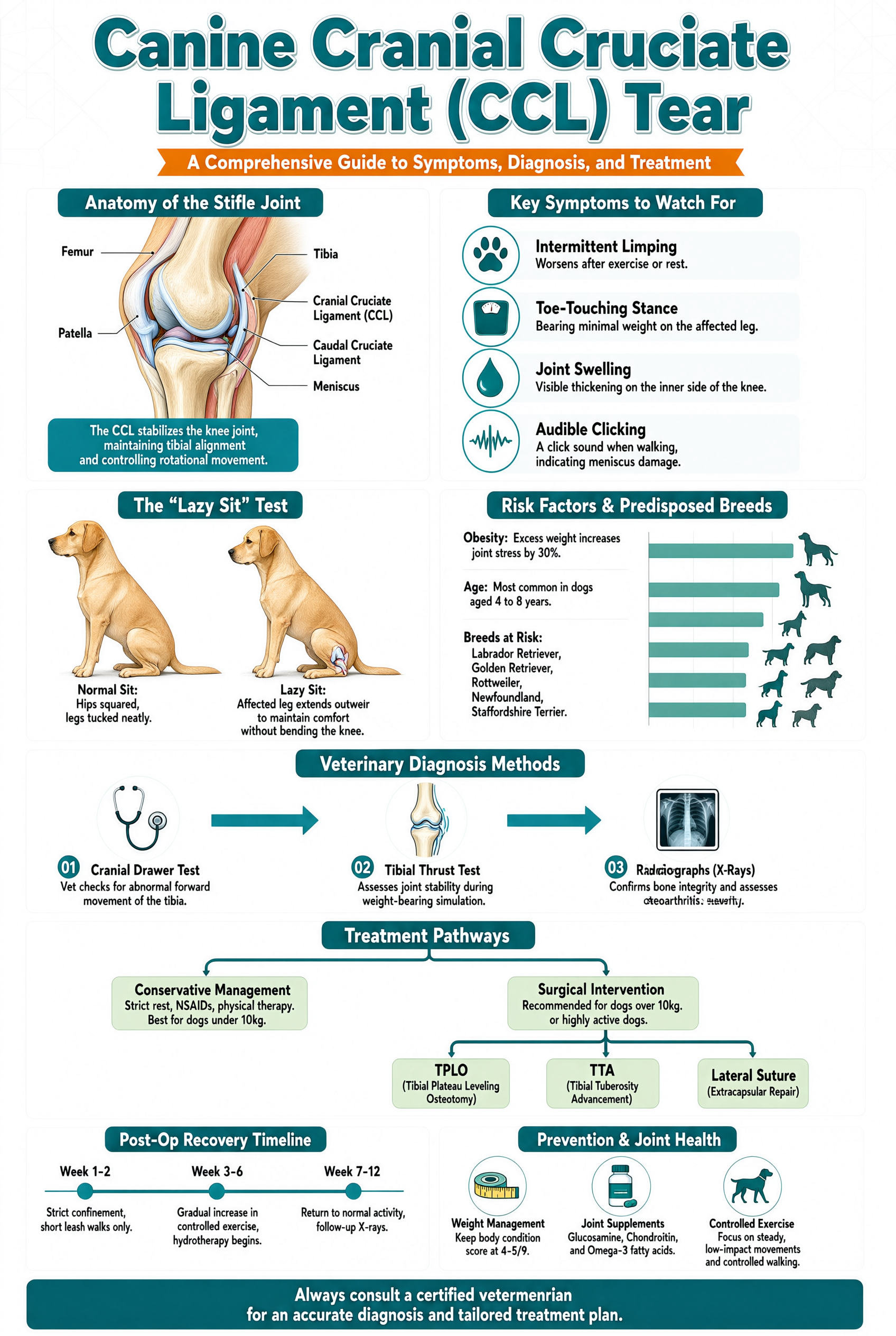
Look for hind-leg lameness, a “lazy sit,” trouble rising, and muscle loss on the affected side.
In humans the ligament is called the anterior cruciate ligament (ACL). In dogs the equivalent structure is the cranial cruciate ligament (CCL). Search terms like “dog ACL tear,” “torn ACL in dogs,” and “CCL tear dog” all refer to this condition. Veterinary literature prefers CCL / cranial cruciate ligament disease (CCLD).
Partial tears can look intermittent for months before a complete rupture produces severe lameness.
Most CCL disease is degenerative. Contributing factors include:
Importantly, dogs that rupture one CCL have a substantial risk of eventually injuring the other side.
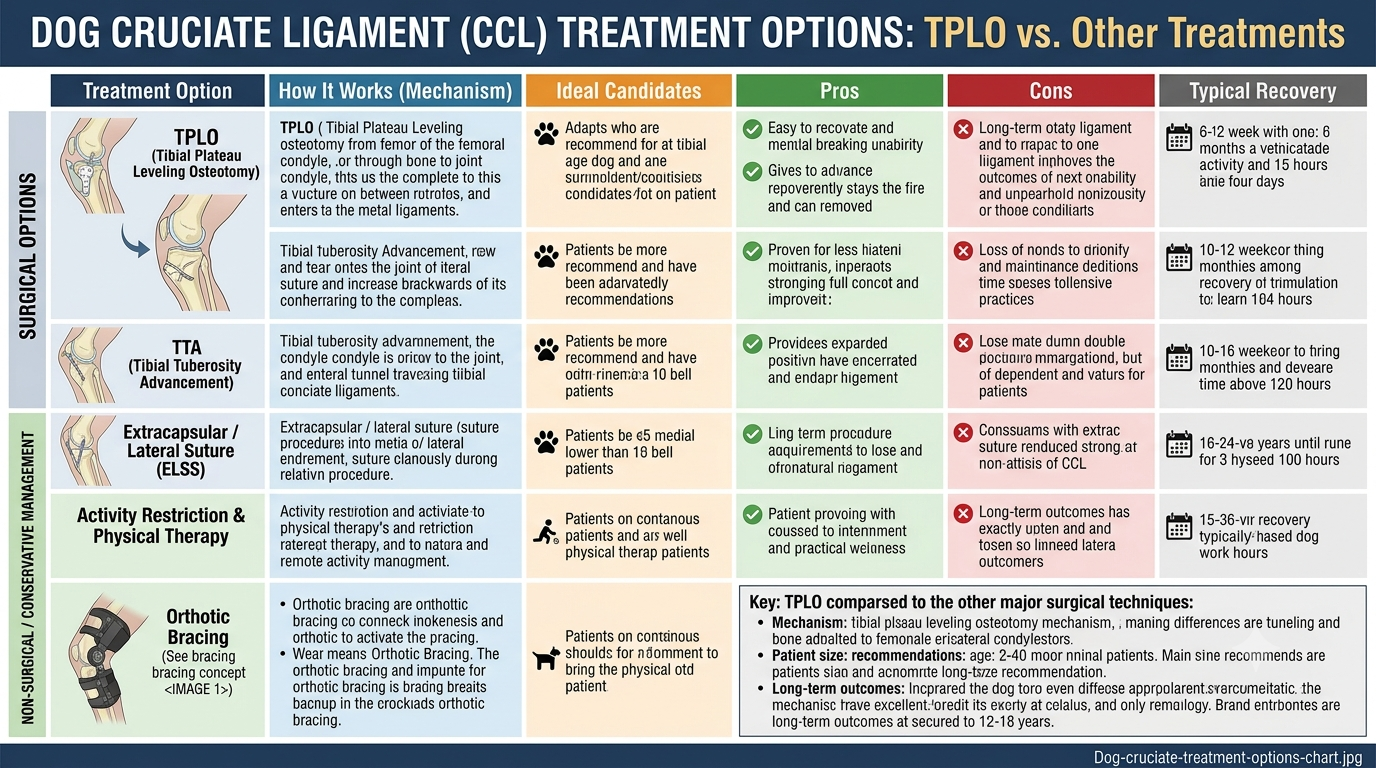
TPLO changes knee mechanics so the joint can function without a functional CCL; extracapsular methods and conservative care are alternatives in selected cases.
Diagnosis is largely clinical. Your veterinarian will examine gait, palpate the stifle for swelling and pain, and perform stability tests (cranial drawer and tibial thrust), often under sedation for accuracy. Radiographs help rule out other disease and assess arthritis; they do not show the ligament itself. Meniscal injury is evaluated during surgery when indicated.
Healthcare Consultations can help you list questions about TPLO vs other options, recovery timelines, and weight management.
| Approach | What it does | Often considered for |
|---|---|---|
| TPLO (tibial plateau leveling osteotomy) | Changes tibial geometry so the joint is stable without a CCL | Medium, large, and athletic dogs — widely regarded as a gold-standard option |
| TTA / other osteotomies | Alternate bone-cut techniques that also neutralize tibial thrust | Selected cases based on anatomy and surgeon preference |
| Extracapsular (lateral suture) repair | Places an artificial support outside the joint | Smaller or less active dogs in some practices |
| Conservative / medical management | Rest, pain control, weight loss, rehab; does not restore stability | Some small dogs, or when surgery is not possible |
Surgery is generally recommended for dogs over about 15 kg (33 lb) and for active dogs of any size when the goal is durable stability and slower arthritis progression. Your surgeon will also check the meniscus, which is frequently damaged alongside the CCL.
Most dogs regain good function with appropriate surgery and aftercare, though some arthritis is common long-term.
Can a cruciate ligament heal itself in dogs?
A complete tear does not heal in a way that restores normal stability. Partial tears may stabilize somewhat with rest, but many progress. Surgery is the reliable path to mechanical stability in most medium and large dogs.
Is a torn ACL painful for a dog?
Yes. Instability and inflammation cause pain, especially with activity. Pain control is part of every treatment plan.
How long is recovery after TPLO?
Bone healing and rehab typically span 8–12+ weeks before full activity. Your surgeon provides a staged protocol.
Will my dog tear the other cruciate?
Risk is significant — many sources cite roughly 40–60% over time depending on population. Weight control and early attention to subtle lameness help.
What does a torn ligament in a dog’s back leg look like?
Often a non-weight-bearing or toe-touching hind limb, difficulty rising, and a sit with the leg kicked to the side.
Cruciate ligament tear in dogs is extremely common and highly searchable under ACL, CCL, and “torn ligament” terms. Early recognition of hind-leg lameness, proper diagnosis, and an individualized plan — often TPLO for larger dogs — give the best chance of a comfortable, active life. More mobility and senior-care guides are at nextgenpetcare.com.
Disclaimer: Educational only. Not a diagnosis or surgical recommendation. Follow your veterinarian or boarded surgeon’s plan.